
Cuckoo CR-1020F Review: 10-Cup Micom Worth the Upgrade?
"The family-size Cuckoo Micom: 10 cups uncooked, auto-clean, GABA and scorched-rice menus, no pressure tax. Buy it when a 5.5-cup Tiger is too small. Do not buy it as a cheaper Cuckoo CRP."
This desk does not run a product test fleet. No coating diary, no invented taste scores, and no invented market-share charts. What follows is Cuckoo America’s CR-1020F page, the US manual’s cup bands, and owner-consensus research.
The leftover version of this review also got the capacity wrong. It called the CR-1020F a “10-cup cooked / 5-cup uncooked” pot and then compared it as the same size as a Tiger JBV-A10U and a Zojirushi NS-TSC10. Those two are 5.5-cup uncooked machines. Cuckoo America lists this one as 10 cups uncooked / 20 cups cooked. That size gap is the actual reason to pay more than a Tiger.

What Cuckoo America ships
| Spec | Official note |
|---|---|
| Model | CR-1020F (US twin CR-1010F in the manual) |
| Type | Micom, non-pressure, heating plate |
| Capacity | 10 cups uncooked / 20 cups cooked |
| Power | 120 V, 60 Hz; about 890 W cook / 135 W warm |
| Size / weight | About 14.9 × 11 × 10.1 in, 10 lb |
| Inner pot | Nonstick coating (the US spec table does not say “Xwall Diamond”) |
| Origin | China |
| In the box | Manual, rice spatula, measuring cup |
Official menu list, condensed: White, Mixed, GABA (brown), thin/thick porridge, scorched rice, soup, soymilk, yogurt, baby food, slow cook, steam, multi-cook, auto-clean, turbo, reheat, keep-warm, preset timer.
Cuckoo America’s own turbo line is the one number this desk will repeat: white rice in about 30 minutes on Turbo. The manual’s turbo band is 2–6 cups, not a full 10-cup pot. Standard white is the 2–10 cup program.
Scorched rice (nurungji / nu rung ji) is a named menu, max 2–4 cups. If that crust is why you are looking at Korean cookers, also read the Cuchen Meejak — different price class, same idea.
Micom here vs a 5.5-cup Tiger
Micom is Cuckoo’s microcomputer label. Same idea as Tiger’s MICOM: the chip runs a soak / heat / steam curve instead of clicking off when a thermostat trips. Longer read: fuzzy logic explained.
It is still not a Cuckoo CRP. No sealed pressure, no IH field. You buy the CR-1020F when you want Cuckoo menus and a large pot without the pressure tax.
Owner consensus on this class of Cuckoo Micom: white rice is the easy win; GABA/brown is the long cycle people actually use on weekends; keep-warm is fine for a meal, not a 12-hour buffet. Treat that as owner language, not a lab keep-warm score.

The size question this page used to get wrong
| Cooker | Uncooked (manufacturer) | Why it is on this page |
|---|---|---|
| Cuckoo CR-1020F | 10 cups | This review |
| Cuckoo CR-0655F | 6 cups | Smaller sibling, same Micom family |
| Tiger JBV-A10U | 5.5 cups | Tacook tray, lower street price |
| Zojirushi NS-TSC10 | 5.5 cups | Micom / keep-warm polish, not a 10-cup pot |
| Zojirushi NS-TSC18 | 10 cups | The Zojirushi that actually matches this size |
If four to eight people eat rice most nights, the 5.5-cup cookers mean a second batch. That is the CR-1020F’s job. If you are two people who liked the Cuckoo name, the CR-0655F is the honest downsize — Cuckoo America lists that one as a 6-cup Micom with a timer and auto-clean, not a “dumb” digital.
CR-1020F vs the keepers people actually compare
Prices move. Check the live listing.
| CR-1020F | CR-0655F | Tiger JBV-A10U | Zojirushi NS-TSC18 | |
|---|---|---|---|---|
| Uncooked cups | 10 | 6 | 5.5 | 10 |
| Control | Micom, no pressure | Micom, no pressure | Micom + Tacook | Micom, no pressure |
| GABA / brown | Yes (2–6 cups) | Yes (GABA on the US menu) | Brown, no GABA | GABA on the TSC family |
| Scorched rice | Yes (2–4 cups) | Not on the short US menu | No | No |
| Auto-clean | Yes | Yes | No | No |
| Side-over-rice tray | No | No | Tacook | No |
| Typical street band | ~$120–$140 | ~$70–$90 | ~$80 | ~$180–$220 |
Stay on the Tiger if 5.5 cups is enough and the plate is the feature. Stay on the CR-0655F if 6 uncooked cups is enough and you want Cuckoo menus without a 15-inch footprint. Step to the NS-TSC18 if you want Zojirushi keep-warm reputation at the same cup count. Step to a CRP only if pressure (or IH pressure) is the texture you already decided you want.
Brand-level note: Zojirushi vs Cuckoo.
Auto-clean, without the leftover hygiene scare
Cuckoo’s auto-clean is a steam cycle after you put water in the pot and pick the menu. The leftover draft cited an NSF “germiest lids” survey this desk cannot stand behind. The honest version: rice-cooker lids collect starch, starch smells, and a steam pass plus a detachable inner lid is why Cuckoo puts auto-clean on Micom boxes. Wash the pot. Run auto-clean when the lid starts to look milky. Full habit guide: How to Clean a Rice Cooker.
This desk has not run a two-month coating check. Non-stick wears if you metal-spoon it. Soft sponge.
Who should buy the CR-1020F
- Households that outgrew a 5.5- or 6-cup pot
- People who want GABA, scorched rice, porridge, and turbo on one Cuckoo Micom
- Buyers who like auto-clean more than a Tacook tray
- Anyone who almost bought a CRP and then saw the price
Skip it if you need induction, a stainless pot, or a cooker that lives in a narrow cabinet. Skip it if 4 cups uncooked is your real max — you are paying for empty space.
Final verdict
Editorial read: 4.5/5 for a large-pot Cuckoo Micom. The upgrade over a Tiger is capacity and Korean menu depth, not a secret rice-quality leap this desk measured.
Check the current price on Amazon →
Related reviews
- Cuckoo CR-0655F — 6-cup Micom sibling
- Cuckoo CR-0675F — 6-cup Micom with Scorched Rice
- Cuckoo CRP — pressure / IH step-up
- TIGER JBV-A10U — 5.5-cup Micom + Tacook
- Zojirushi NS-TSC10 — smaller Zojirushi Micom
- Best Rice Cooker Under $100
- Rice cooker size guide
- Zojirushi vs Cuckoo
✅ Pros
- 10 cups uncooked / 20 cups cooked — a true family pot, not a 5.5-cup Micom
- Cuckoo America lists it as Micom, with Turbo, GABA/brown, scorched rice, and auto-clean
- Preset timer, keep-warm, and reheat on the official menu list
- Detachable inner lid; steam-clean cycle so the starch job is not all hand-washing
- Non-pressure, so the lid and workflow stay simpler than a CRP
❌ Cons
- Heating-plate Micom, not induction and not twin-pressure
- Non-stick inner pot (Cuckoo America: nonstick coating) is a wear item
- Footprint is a 10-cup machine — about 15 × 11 × 10 in
- No Tacook-style tray; steamer is a menu, not a synchro plate
Frequently Asked Questions
What is micom in the Cuckoo CR-1020F?
Micom means microcomputer. Cuckoo America lists the CR-1020F as a Micom, non-pressure cooker: thermal sensors plus a chip that runs named menus (white, mixed, GABA/brown, turbo, porridge, scorched rice, auto-clean) instead of a single on/off thermal switch.
Is the Cuckoo CR-1020F the same as the CRP models?
No. CRP units add pressure (and the expensive ones add induction). The CR-1020F is heating-plate Micom only. You get Cuckoo menus and auto-clean without the pressure lid, hiss, and price.
How much rice can the Cuckoo CR-1020F actually cook?
Cuckoo America: 10 cups uncooked / 20 cups cooked. The US manual's white-rice band is 2–10 cups; turbo and GABA max out lower (turbo 2–6, GABA 2–6, scorched rice 2–4, mixed/brown 2–8). Do not treat '10-cup' as 10 cups cooked — that was a leftover error on this page.
Does the auto steam clean really work?
Cuckoo's auto-clean / steam-sterilize cycle runs a steam pass over the inner lid and valve path so you are not scraping starch off a sealed lid every night. It does not replace washing the inner pot. Owner reports treat it as less scrubbing, not a dishwasher.
Is the Cuckoo CR-1020F better than the Tiger JBV-A10U?
Different jobs. The JBV-A10U is a 5.5-cup Micom with a Tacook plate. The CR-1020F is a 10-cup Micom with GABA, scorched rice, turbo, and auto-clean. If you need the larger pot, the Cuckoo is the upgrade. If you want a side steamed over the rice at ~$80, stay on the Tiger.
Can the Cuckoo CR-1020F cook GABA rice?
Yes. Cuckoo America lists GABA Rice (Brown Rice) as a menu. The US manual caps that program at 2–6 cups. It is a long germinated-brown cycle, not a 45-minute white-rice button.
🍚 You Might Also Like
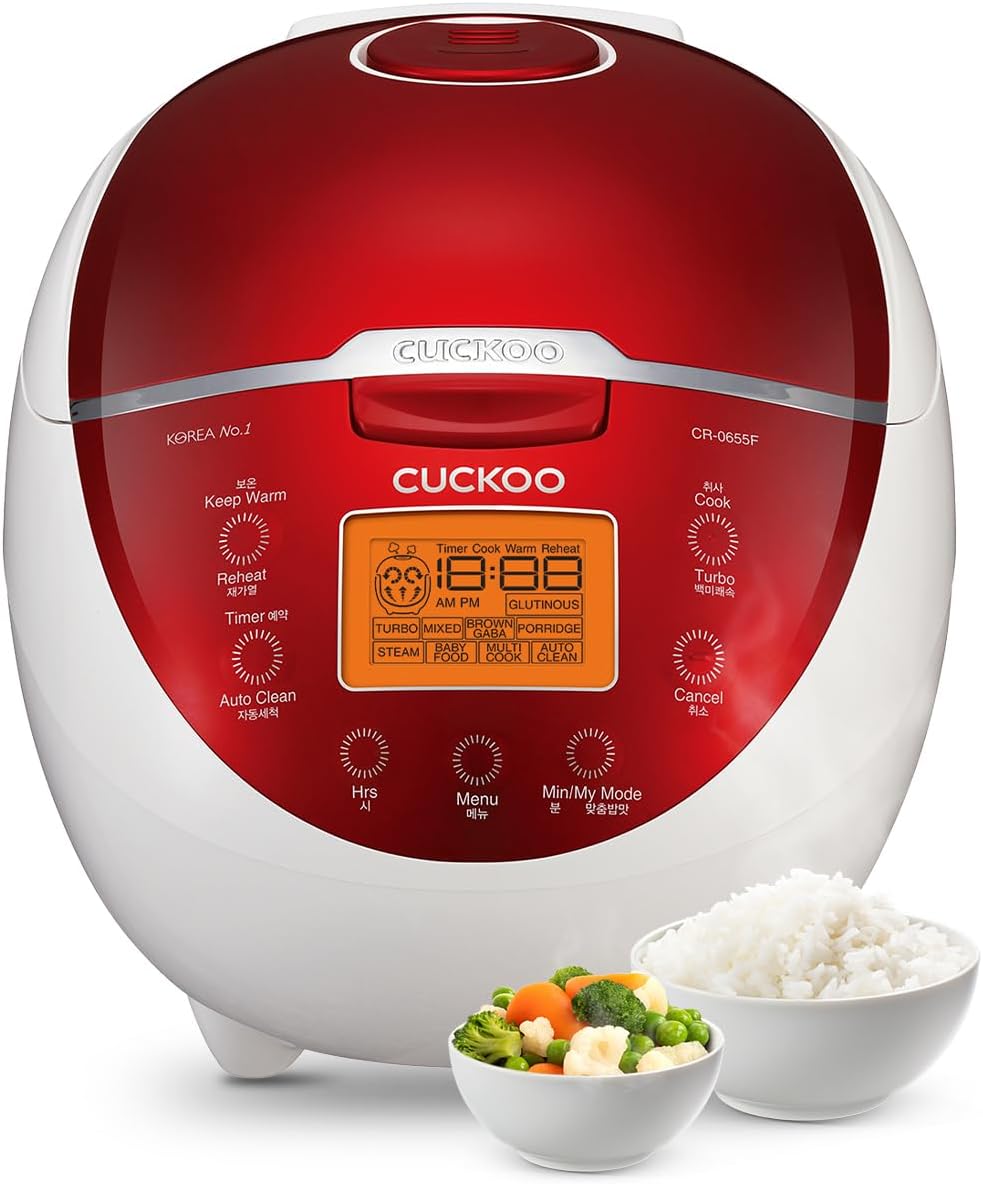
Cuckoo CR-0655F Review: The Budget Cuckoo That Surprises
Cuckoo America's 6-cup Micom: timer, turbo, GABA/brown, auto-clean, no pressure. Buy it when you want Cuckoo menus in a smaller pot. Do not buy it as a 'dumb digital' — and do not expect a Tacook tray.
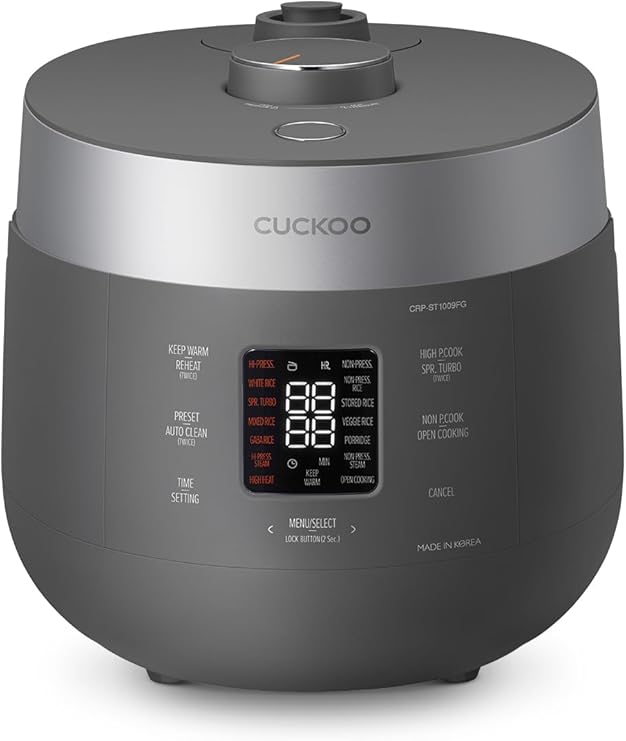
CUCKOO CRP-ST1009FG Review: The Twin Pressure Master
If you want speed AND texture options, this is the one to buy.
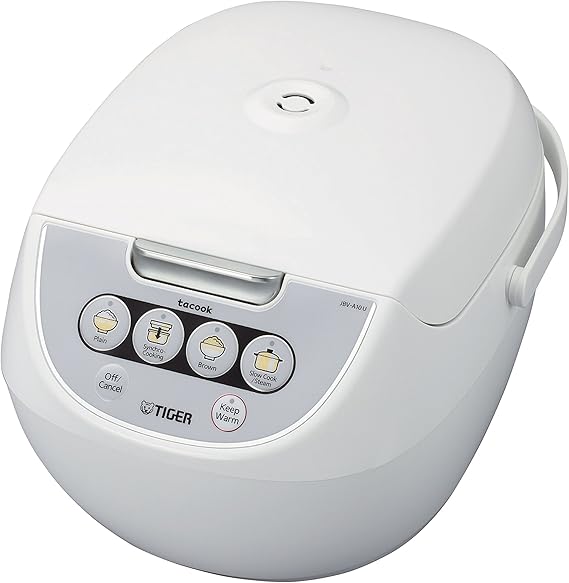
TIGER JBV-A10U Review: 5.5-Cup Micom With Synchro-Cooking
A reliable daily driver that just works. Highly recommended for students and small families.
Ready to Upgrade Your Rice Game?
The Cuckoo CR-1020F is waiting for you. Perfect rice, every time.
Buy on Amazon 🍚 🛒